AI Is Transforming Business — But Implementation Determines Success

How Voice AI Is Transforming Small & Medium Enterprises: Faster Growth, Better Customer Experience, and Measurable ROI
May 10, 2026
From Experimentation to Transformation: How SMEs Are Scaling AI Adoption Through AI Maturity
May 24, 2026
AI is reshaping the global business landscape faster than any technology shift in recent decades.
Organizations across industries are adopting AI for:
- Customer service
- Operations
- Analytics
- Automation
- Sales and marketing
- Decision-making
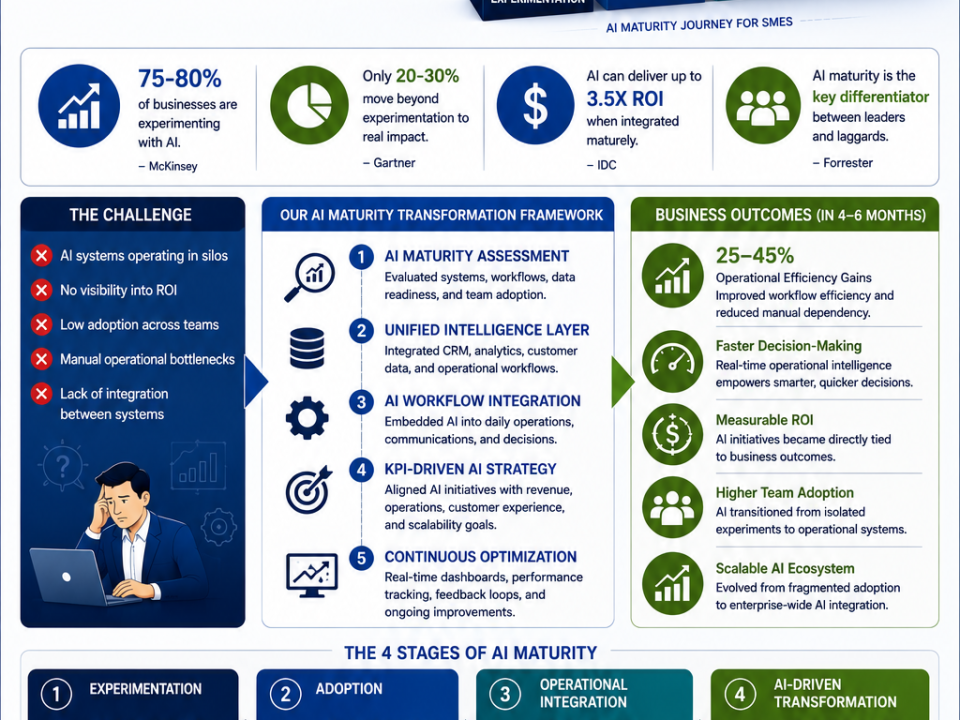
Recent industry studies show that more than 75% of enterprises are actively using AI in at least one business function. AI adoption is also projected to contribute trillions of dollars to the global economy over the coming years. (mckinsey.com)
But there’s a major reality most companies overlook:
AI adoption does not automatically create business success.
Implementation does.
At JW Infotech, we consistently see organizations investing heavily in AI tools but failing to generate measurable business impact because of poor implementation strategies.
The Client
A growing enterprise in the service and operations sector approached JW Infotech after struggling to scale AI initiatives.
The company had already invested in:
- AI dashboards
- Automation tools
- AI-powered analytics
- CRM intelligence systems
Yet business performance remained inconsistent.
The Challenge
Despite adopting AI, the organization faced:
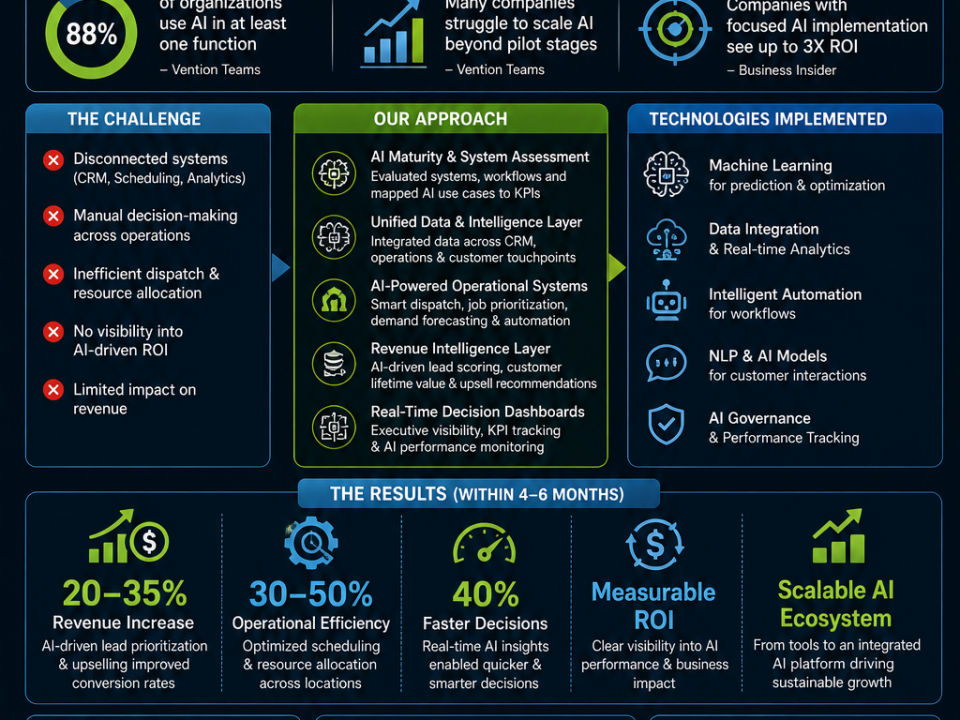
❌ No clear ROI visibility
❌ Fragmented systems and workflows
❌ Low AI adoption across teams
❌ Poor operational integration
❌ Limited decision intelligence
The company had AI tools.
But not AI systems.
This reflects a broader trend across industries where organizations experiment with AI but struggle to operationalize it effectively. (forbes.com)
The Core Problem
The issue wasn’t AI capability.
It was:
Lack of structured implementation
AI success depends on:
- Data integration
- Workflow alignment
- Business KPI mapping
- Team adoption
- Operational execution
Without these, AI remains isolated technology rather than business transformation.
JW Infotech’s AI Implementation Framework
JW Infotech implemented a structured transformation model focused on execution, integration, and scalability.
1. AI Maturity Assessment
We evaluated:
✔ Existing AI systems
✔ Workflow integration gaps
✔ Data readiness
✔ Business process alignment
✔ Operational bottlenecks
2. Unified Data & Intelligence Layer
We integrated:
- CRM systems
- Operational workflows
- Analytics dashboards
- Customer interaction data
This created a centralized intelligence ecosystem.
3. AI Workflow Integration
Instead of isolated AI tools, we embedded AI directly into:
✔ Daily operations
✔ Decision-making systems
✔ Customer workflows
✔ Resource allocation processes
Research shows AI delivers the highest value when integrated deeply into operational systems rather than used as standalone technology. (deloitte.com)
4. KPI-Driven AI Execution
Every AI initiative was mapped to:
- Revenue goals
- Operational efficiency
- Customer experience metrics
- Performance KPIs
5. Real-Time Visibility & Optimization
JW Infotech implemented:
✔ Executive dashboards
✔ AI performance tracking
✔ Continuous optimization loops
✔ Real-time decision systems
Business Outcomes
Within 4–6 months:
🚀 1. 20–40% Operational Efficiency Gains
AI-enabled workflows improved speed and reduced manual dependency.
📊 2. Faster Decision-Making
Leadership gained real-time visibility into operations and performance.
💰 3. Measurable ROI from AI
AI initiatives became tied directly to business outcomes and revenue metrics.
⚡ 4. Improved Team Adoption
AI moved from isolated experiments → operational systems.
🔁 5. Scalable AI Ecosystem
The organization transitioned from fragmented AI usage to enterprise-wide AI integration.
The Bigger Insight
Across industries, the companies succeeding with AI are not necessarily the ones investing the most.
They are the ones:
✔ Implementing strategically
✔ Integrating deeply
✔ Aligning AI with business goals
✔ Operationalizing AI effectively
Why Implementation Matters More Than Adoption
AI alone does not create transformation.
Implementation determines:
- Scalability
- ROI
- Operational efficiency
- Adoption success
- Long-term impact
The gap between AI experimentation and AI-driven growth is execution.
Final Takeaway
The companies winning with AI are not asking:
“Which AI tool should we use?”
They are asking:
“How do we integrate AI into the way our business operates?”
How JW Infotech Helps
At JW Infotech, we help organizations:
✔ Implement scalable AI systems
✔ Align AI with business outcomes
✔ Build AI maturity frameworks
✔ Integrate AI into operations
✔ Drive measurable business impact