From Visibility to Velocity: How AI Dashboards + Maturity Assessment Helped an SME Achieve Real-Time Decision Intelligence

From Tools to Transformation: How AI Maturity Assessment Helped a US Plumbing Services Company Scale AI for Real Business Impact
March 28, 2026
From AI Adoption to ROI: How Maturity-Driven AI Strategy Transformed Business Outcomes
April 12, 2026
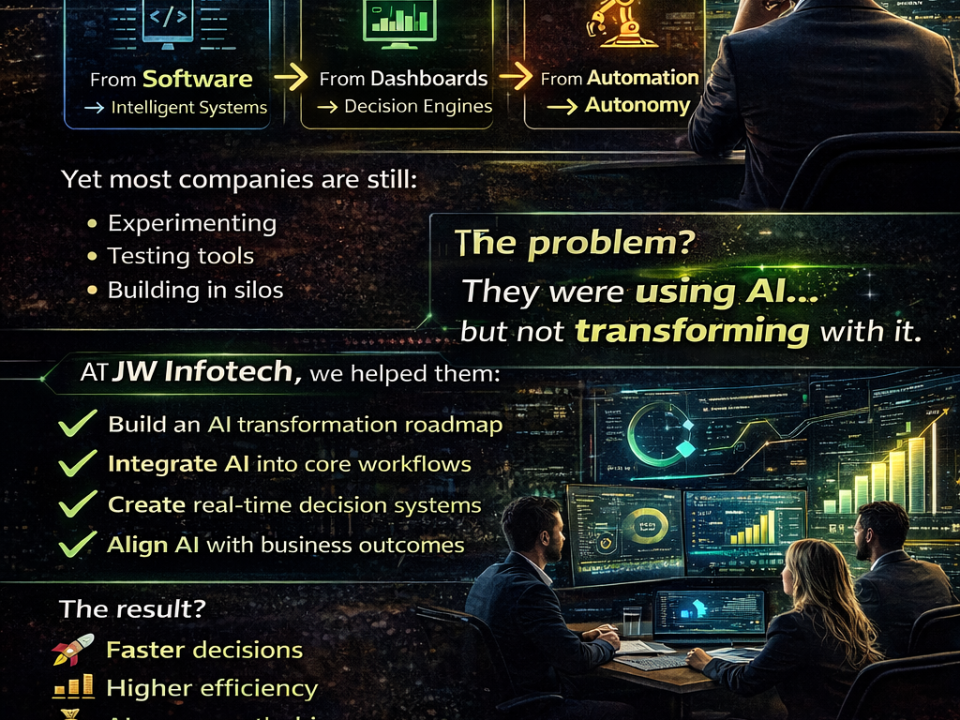
Across industries—from manufacturing and hospitality to service operations—businesses are rapidly adopting AI tools.
But a consistent pattern emerges:
High adoption. Low clarity. Limited impact.
Recent case studies by JW Infotech highlight how organizations using AI dashboards, automation systems, and AI-driven workflows often struggle until they align technology with data, processes, and decision-making frameworks
This case study demonstrates how JW Infotech helped an SME transition from fragmented AI usage to a unified, intelligence-driven system.
The Client
A mid-sized multi-location SME operating in:
- Operations-heavy workflows
- Customer-facing service delivery
- Multi-team coordination environments
They had already implemented:
- Basic dashboards
- CRM tools
- Automation workflows
- Some AI-enabled features
The Challenge
Despite investments in technology, the business faced:
❌ Lack of real-time visibility
❌ Delayed decision-making
❌ Disconnected data sources
❌ Inefficient resource allocation
❌ No measurable ROI from AI tools
This aligns with a common pattern seen across JW Infotech case studies:
Businesses deploy AI, but fail to integrate it into decision systems and workflows
The Core Problem
The issue wasn’t technology.
It was lack of AI maturity and intelligence architecture.
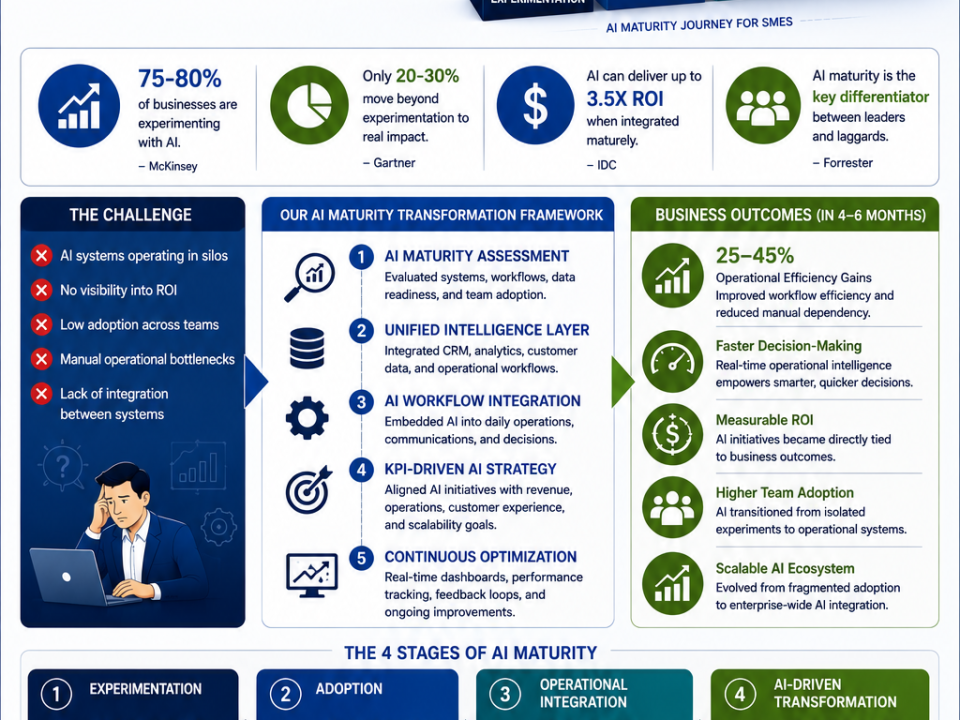
JW Infotech’s Strategic Approach
JW Infotech implemented a dual-layer transformation model:
1. AI Maturity Assessment
A structured evaluation across:
Data Layer
- Data silos and fragmentation
- Quality and accessibility
Systems Layer
- Existing tools and integrations
- Workflow connectivity
Decision Layer
- How decisions are made
- Availability of real-time insights
Organizational Layer
- Team adoption
- Leadership alignment
2. AI Dashboard & Intelligence System
Inspired by frameworks like NexaSight and operational dashboards used in prior case studies
Implementation included:
✔ Real-time operational dashboards
✔ AI-powered analytics layer
✔ Predictive insights (demand, performance)
✔ Role-based decision dashboards
Key Interventions
1. Unified Data Infrastructure
- Integrated CRM, operations, and analytics data
- Created a single source of truth
2. Real-Time Decision Dashboards
- Executive-level visibility
- Team-level actionable insights
3. AI-Driven Operational Intelligence
- Resource allocation optimization
- Workflow efficiency tracking
4. Predictive Analytics Layer
- Forecasting demand and performance
- Identifying inefficiencies before impact
5. KPI Alignment Framework
- AI linked directly to business outcomes
- Performance tracked in real time
Business Outcomes
Within 3–6 months:
🚀 1. 35% Faster Decision-Making
Leadership shifted from reactive → real-time decisions
📊 2. 25–40% Efficiency Gains
Operational workflows optimized
💰 3. Clear ROI Visibility
Every AI system mapped to measurable outcomes
⚡ 4. Improved Resource Utilization
Teams deployed more effectively
🔁 5. Scalable Intelligence System
Shift from tools → integrated AI ecosystem
The Bigger Insight
Across JW Infotech case studies, one theme is consistent:
AI dashboards and automation only work when connected to decision-making systems
Final Takeaway
The real transformation is not:
“Using AI tools”
It is:
“Building systems where AI drives decisions”
How JW Infotech Helps
JW Infotech enables businesses to:
✔ Assess AI maturity
✔ Build intelligence-driven systems
✔ Implement AI dashboards & analytics
✔ Align AI with business KPIs
✔ Scale AI across operations
As highlighted in their core capabilities, the focus remains on data, AI, automation, and enterprise transformation