Revolutionising Voice Calling with AI-Agent Innovation

Transforming Franchise Hotels with AI-Driven Efficiency
November 5, 2025
Video Analytics Transformed with YOLO + SAM
November 25, 2025
For many organisations, voice calling remains a critical—and often expensive—touchpoint. Long wait times, low conversion rates, and high support costs plague call-centres. By introducing a purpose-built AI voice agent, we turned this challenge into an opportunity. The solution provided real-time call initiation, intelligent conversation handling, and integration with backend systems—shifting from reactive calling to proactive engagement.
In this project, roles spanned:
- Project Manager: orchestrated delivery, timelines and stakeholder alignment
- AI Engineer: built and optimised voice-agent models
- Business Analyst: measured business impact, tracked KPIs and interpreted outcomes
The Challenge
- Lead call-backs often took hours instead of minutes, reducing conversion possibility.
- Agents manually dialed leads, resulting in idle time and inconsistent workflows.
- Call-centre supervisors lacked real-time visibility of throughput, caller quality and conversion metrics.
- Operational costs remained high while business outcomes lagged.
The Solution
Project Manager’s perspective:
We opted for a hybrid model—rapid proof-of-concept followed by agile iterations. A cross-functional team was mobilised, milestones set for model deployment, integration and measurement. Weekly sprints allowed quick feedback loops.
AI Engineer’s perspective:
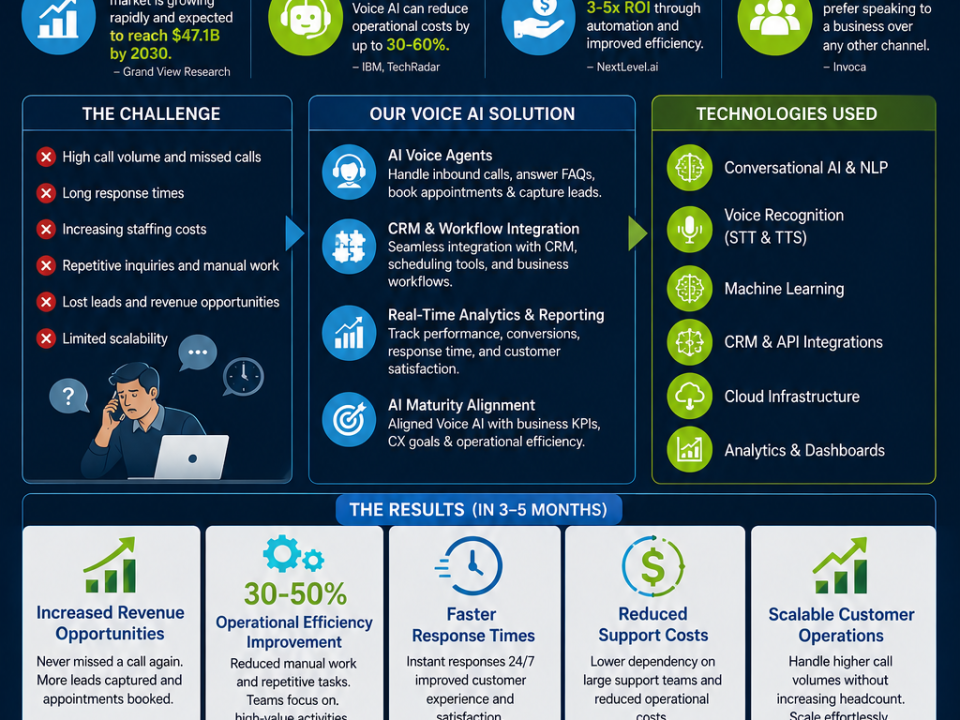
We developed an AI voice-agent using speech recognition, intent classification and dynamic script delivery. The agent accessed the CRM, triggered calls within 5 minutes of lead capture, handled common objections, and transferred calls seamlessly to human agents when needed.
Business Analyst’s perspective:
We defined key metrics: call-back time, conversion rate, agent utilisation, cost per call. Baseline data was collected pre-deployment to quantify improvement.
Outcomes & Analytics
- Call-back time reduced from several hours to under 10 minutes on average.
- Lead conversion rate improved by ~30-40% within the first month of agent deployment.
- Agent utilisation increased meaningfully: human agents handled more complex calls, while the AI agent handled high-volume, repetitive interactions.
- Operational cost per dialled lead decreased due to automation and fewer idle agent hours.
- Real-time dashboards gave supervisors actionable visibility into call volume, drop-off points and script performance.
Key Roles & Responsibilities
- Project Manager: Defined deliverables, managed stakeholder reviews, tracked progress.
- AI/ML Engineer: Developed and tuned the voice-agent, integrated with telephony systems and CRM.
- Data Engineer: Built data pipelines to feed models, ensure logging and metric capture.
- Business Analyst: Interpreted KPIs, advised on script changes and performance improvements.
- Operations Lead: Handled deployment logistics, agent training and change management.
Best Practices & Lessons Learned
- Rapid pilot → scale model: Start small, measure strong results, then scale across channels.
- Human-in-the-loop logic: The AI agent hand-off to humans must be seamless to maintain quality.
- Measure what matters: Real-time dashboards drive decisions and optimise script flows.
- Change management: Human agents must be re-skilled from pure dialing to supervisory/closer roles.
- Continuous improvement: Regular script updates and model retraining ensure relevance and performance.
Conclusion
Implementing an AI-voice calling agent can significantly change the efficiency matrix: faster lead engagement, higher conversions, better agent utilisation and lower costs. For organisations ready to modernise their call operations, the future is no longer about more agents—it’s about smarter conversations driven by AI.