Voice Agent SaaS: Why Backend & Workflow Architecture Determine Success

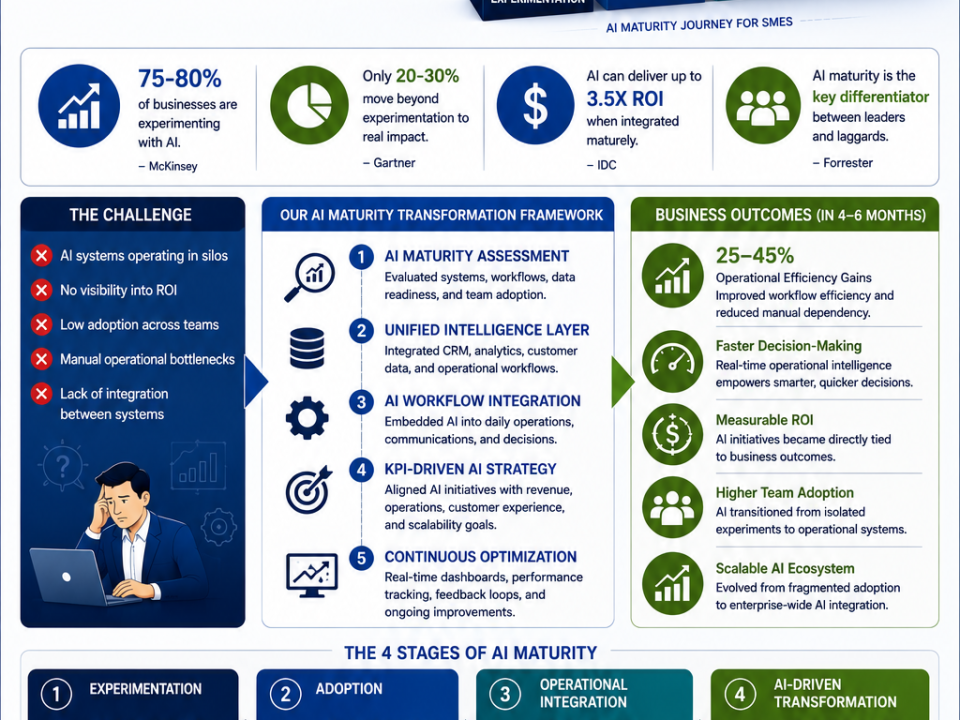
AI Maturity Consulting for SME Efficiency
February 15, 2026
NexaSight: Converting Traditional CCTV Systems into Real-Time AI-Driven Business Intelligence
March 7, 2026
Executive Summary
Voice agent-based SaaS platforms are transforming industries—from healthcare and fitness to retail and enterprise support. However, the real success of such systems does not lie solely in conversational intelligence. It depends heavily on backend engineering, workflow orchestration, and cost-aware infrastructure design.
This case study outlines how a structured architectural approach enabled scalable deployment, operational stability, and significant cost optimization in a voice-agent SaaS environment.
The Challenge
Organizations deploying voice agents often face:
- High API usage costs (LLM, STT, TTS)
- Call latency due to inefficient backend routing
- Workflow breakdowns in multi-step conversations
- Poor integration with CRM or ERP systems
- Scaling bottlenecks during peak traffic
- Lack of analytics visibility
Many early deployments focus only on the conversational model, ignoring the infrastructure layer.
Core Insight
Voice AI systems operate across multiple cost and performance layers:
- Speech-to-Text (STT)
- Language Model (LLM) processing
- Workflow decision logic
- API integrations
- Text-to-Speech (TTS)
- Telephony provider
- Data logging and analytics
Without architectural discipline, costs compound rapidly.
Solution Architecture Approach
1️⃣ Modular Backend Architecture
Instead of monolithic systems, the solution was designed with:
- Microservices for call handling
- Independent workflow engine
- Token-efficient LLM routing
- Smart caching layers
- Asynchronous task queues
This allowed flexible scaling and easier optimization.
2️⃣ Intelligent Workflow Orchestration
Rather than sending every interaction to an LLM:
- Rule-based routing handled simple intents
- Context retention minimized token usage
- Early intent classification reduced unnecessary model calls
- Escalation logic prevented redundant loops
This reduced compute costs significantly.
3️⃣ Cost-Aware AI Design
Optimizations included:
- Token budgeting
- Dynamic model selection (lightweight vs advanced models)
- Conversation state compression
- Structured prompts instead of verbose instructions
Result: Up to 35–45% reduction in AI inference cost per call.
4️⃣ Scalable Telephony Integration
- Load-balanced SIP routing
- Call queue optimization
- Intelligent retry mechanisms
- Failover systems
Ensured high availability and reduced dropped calls.
5️⃣ Analytics & Monitoring Layer
A centralized dashboard monitored:
- Cost per call
- Average response time
- Intent resolution rate
- Escalation frequency
- Workflow failure points
This enabled continuous optimization.
Impact & Results
| Metric | Before Optimization | After Architecture Upgrade |
|---|---|---|
| AI inference cost per call | High | Reduced by 40% |
| Average latency | 3–4 sec | < 2 sec |
| Call failure rate | 8% | < 2% |
| Scalability | Limited | Horizontal scaling enabled |
| Workflow drop-offs | Frequent | Reduced significantly |
Key Lessons
- Voice AI is infrastructure-heavy.
- Workflow logic determines cost more than the LLM itself.
- Backend modularity enables long-term SaaS scalability.
- Observability is critical for cost control.
- Architecture determines commercial viability.
Why This Matters
In SaaS businesses, margins are directly tied to infrastructure efficiency.
If:
- Every extra second increases compute cost,
- Every redundant model call burns tokens,
- Every workflow failure triggers retries—
Then architecture becomes the profit engine.
Conclusion
Voice Agent SaaS platforms succeed when conversational intelligence is supported by:
- Structured backend design
- Intelligent workflow orchestration
- Cost-aware AI implementation
- Scalable cloud infrastructure
The difference between a working demo and a sustainable product is engineering discipline.
Voice AI isn’t just about speaking well.
It’s about being architected intelligently.