From Data to Decisions: How Advanced Analytics Transformed Business Performance

NexaSight: Converting Traditional CCTV Systems into Real-Time AI-Driven Business Intelligence
March 7, 2026
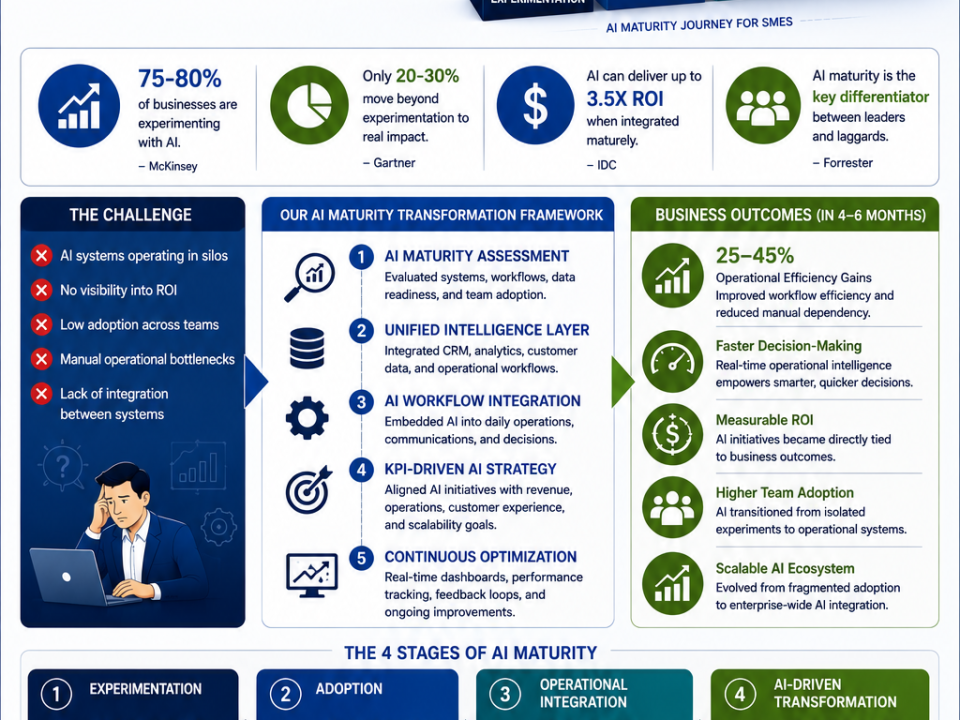
From Experimentation to Scale: How AI Maturity Assessment Helped an AI-First Company Unlock Real Business Impact
March 22, 2026
Introduction
In the digital economy, businesses generate enormous volumes of data every day—from customer interactions and sales transactions to operational metrics and marketing campaigns. However, raw data alone does not create value. The real competitive advantage comes from transforming data into actionable insights through analytics.
Organizations that adopt analytics-driven decision-making gain clearer visibility into operations, customer behavior, and future trends, enabling faster and more accurate decisions.
This case study explores how a mid-sized enterprise leveraged advanced analytics and data intelligence to improve operational efficiency, increase revenue visibility, and create a scalable data-driven culture.
The Challenge
A growing services company operating across multiple cities was facing several operational challenges:
- Fragmented data across CRM, finance, and marketing platforms
- Lack of real-time visibility into business performance
- Inefficient decision-making driven by intuition rather than data
- Difficulty identifying customer trends and sales patterns
- Delayed reporting cycles impacting leadership decisions
As the company scaled, leadership realized that traditional reporting systems were insufficient for strategic decision-making.
Without analytics, data remained underutilized.
The Strategic Solution
JW Infotech implemented a comprehensive analytics framework that integrated multiple data sources and delivered actionable insights through dashboards and predictive analytics.
The solution consisted of:
1. Unified Data Architecture
Data from CRM systems, operational tools, finance platforms, and marketing campaigns was integrated into a centralized analytics platform.
This allowed the organization to break down data silos and create a single source of truth for decision-making.
2. Real-Time Business Intelligence Dashboards
Interactive dashboards were developed for different leadership levels:
Executive dashboards
- Revenue performance
- Sales pipeline trends
- Customer acquisition metrics
Operational dashboards
- Team productivity
- Customer engagement
- Conversion rates
Marketing dashboards
- Campaign performance
- Lead attribution
- ROI tracking
Analytics allowed leadership to monitor key metrics in real time.
3. Predictive Analytics
Using machine learning models and historical data patterns, the system predicted:
- Sales trends
- Customer churn probability
- Demand fluctuations
- Seasonal performance variations
This allowed leadership to move from reactive decision-making to predictive planning.
Organizations increasingly rely on analytics to forecast trends and optimize strategies based on data-driven insights.
Implementation Architecture
The analytics ecosystem included:
- Data pipelines integrating multiple platforms
- Data warehouse for structured storage
- Visualization dashboards
- Predictive analytics models
- AI-assisted reporting tools
This architecture enabled the company to process thousands of data points daily and convert them into meaningful insights.
Key Business Outcomes
Within six months of implementing the analytics framework, the organization achieved measurable improvements.
1. Faster Decision-Making
Leadership could access real-time insights instead of waiting for monthly reports.
Decision cycles reduced by 60%.
2. Revenue Optimization
Analytics identified high-performing customer segments and sales patterns.
Marketing campaigns became more targeted and effective.
3. Operational Efficiency
The company identified inefficiencies in operational workflows and optimized resource allocation.
Data analytics helps organizations identify inefficiencies and improve operational processes.
4. Cost Reduction
Operational analytics helped eliminate redundant activities and streamline workflows.
Companies that leverage analytics often experience improved efficiency and cost reductions.
5. Data-Driven Culture
Most importantly, analytics created a cultural shift inside the organization.
Instead of asking:
“What do we think?”
Teams began asking:
“What does the data say?”
The Bigger Impact of Analytics
Across industries, analytics is becoming a strategic driver of business success.
Organizations leveraging advanced analytics report:
- Better strategic decisions
- Improved operational control
- Deeper customer understanding
- Higher revenue growth
Companies using big data analytics have reported revenue increases of around 8% and cost reductions of roughly 10% on average.
Why Analytics Is No Longer Optional
Modern businesses operate in environments where:
- customer expectations change rapidly
- markets evolve quickly
- competition is data-driven
Organizations that fail to adopt analytics risk making decisions based on incomplete information.
Analytics enables companies to identify trends early, optimize processes, and create long-term strategic advantages.
How JW Infotech Helps Businesses Build Analytics-Driven Organizations
At JW Infotech, we help businesses unlock the full potential of their data through:
- Business Intelligence Platforms
- AI-Powered Analytics
- Predictive Modeling
- Data Engineering Pipelines
- Executive Decision Dashboards
Our mission is simple:
Turn data into intelligence and intelligence into impact.